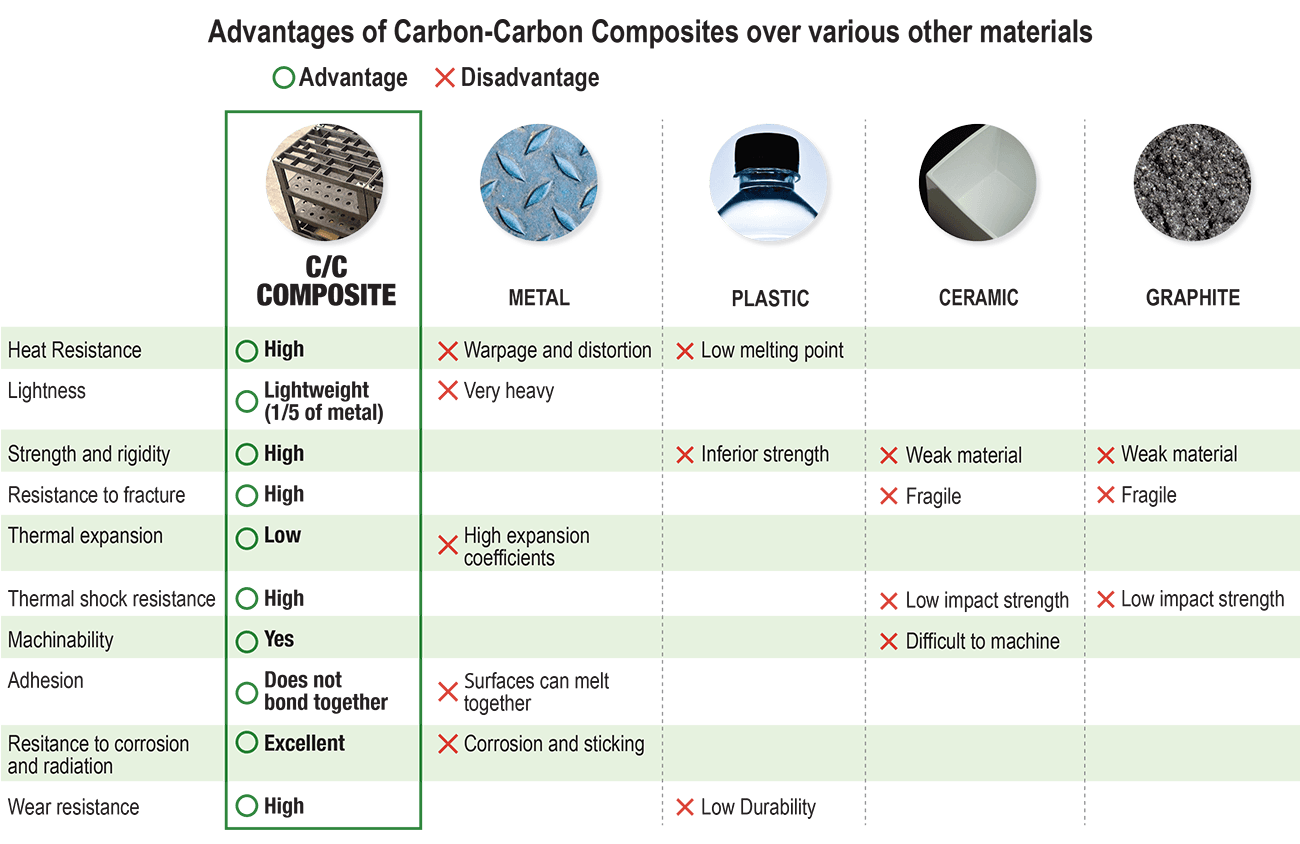
When selecting materials for high-performance applications, it is crucial to understand their strengths and limitations. Carbon-carbon (C/C) composites stand out as a superior choice compared to metals, plastics, ceramics, and graphite due to their exceptional heat resistance, structural integrity, and longevity.
Unlike metals, which suffer from warpage and distortion, and plastics, which have low melting points, C/C composites offer high thermal stability. This makes them ideal for environments exposed to extreme temperatures, such as aerospace, industrial furnaces, and automotive braking systems.
C/C composites are five times lighter than metal, providing significant weight savings while maintaining high strength and rigidity. Unlike plastics and ceramics, which have inferior strength or are prone to brittleness, C/C composites deliver unmatched resistance to fracture, ensuring long-term durability.
Thermal expansion can lead to structural deformation in metals due to their high expansion coefficients. C/C composites, however, exhibit low thermal expansion, minimizing material distortion under extreme heat. Additionally, unlike ceramics and graphite, which suffer from low impact strength, C/C composites demonstrate high thermal shock resistance, making them highly reliable in fluctuating temperature environments.
Unlike ceramics, which are difficult to machine, C/C composites are highly machinable, making them versatile for precision applications. Their unique composition also prevents bonding or surface melting, a common issue with metals that can lead to corrosion and sticking.
C/C composites excel in environments that demand long-term exposure to harsh conditions. Their excellent resistance to corrosion and radiation surpasses metals, which often corrode and degrade. Additionally, they maintain high wear resistance, unlike plastics, which suffer from low durability over time.
For industries that demand high heat tolerance, strength, and reliability, C/C composites provide a superior alternative to metals, plastics, ceramics, and graphite. Their unique combination of lightweight properties, thermal stability, mechanical strength, and corrosion resistance makes them the material of choice for advanced engineering applications.

At Across-CFC, sustainability is a core principle guiding our material innovations. By transitioning from traditional metals and graphite to carbon-carbon (C/C) composites, we help industries minimize environmental impact while maximizing efficiency. Our solutions support energy conservation, reduced waste, and extended product lifespan, aligning with global efforts toward a more sustainable and responsible future.
We prioritize modern environmentally friendly processes:
Traditional metal processing requires high-energy-intensive methods such as mining, smelting, and refining. C/C composites eliminate these energy-heavy steps, resulting in a reduced carbon footprint.
Unlike metals that corrode or wear down over time and graphite that is fragile, C/C composites are exceptionally durable. Their longer operational life reduces the need for frequent replacements, cutting down on waste and resource consumption.
C/C composites allow for lighter, more compact designs, reducing material usage and improving efficiency in manufacturing, transportation, and application. This leads to lower emissions and optimized industrial processes.
With improved durability and reduced processing time, companies using C/C composites save on energy and operational expenses, reinforcing both economic and environmental sustainability.
Our sustainability initiatives directly align with key United Nations Sustainable Development Goals (SDGs):
We drive energy efficiency improvements by providing materials that require less energy-intensive processing while enhancing performance in high-temperature environments.
By advocating for sustainable industrialization, we help businesses transition away from resource-heavy materials toward innovative, eco-friendly alternatives that optimize performance and minimize waste.
Carbon-Carbon (C/C) composites are advanced materials composed entirely of carbon fibers embedded within a carbon matrix. This unique structure endows them with exceptional properties, making them indispensable in various high-performance applications.
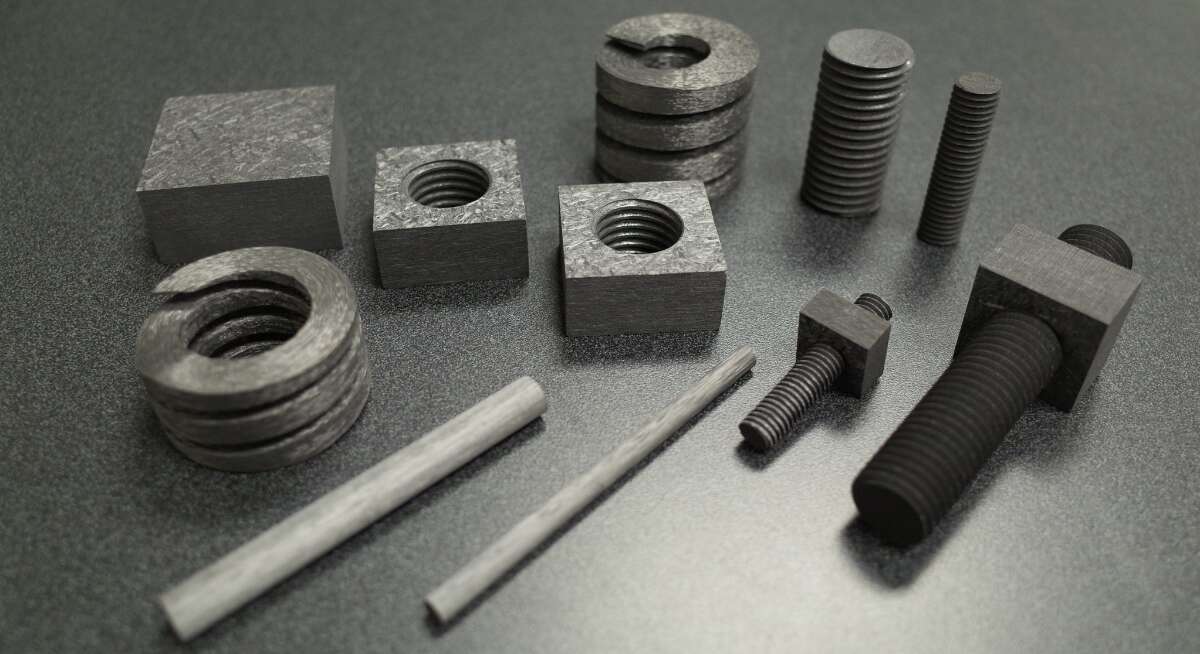
At Across-CFC, we specialize in designing and manufacturing C/C composites tailored to meet the specific demands of various industries. Our innovative preformed yarn (PY) method streamlines production, resulting in cost-effective and high-quality C/C components. By choosing our C/C solutions, businesses can achieve superior performance while contributing to environmental sustainability through reduced energy consumption and material waste.
Embrace the future of material innovation with Across-CFC's Carbon-Carbon composites—where unparalleled performance meets sustainable design.
This FAQ is intended for companies and engineers evaluating Carbon-Carbon composite (C/C) for high-temperature industrial applications. It covers material fundamentals, performance limits, manufacturing considerations, and commercial expectations.
Both C/C composite and graphite are carbon-based materials, but they differ significantly in structure and performance.
The primary difference is the matrix material.
The terms Carbon-Carbon composite, C/C, CFC (Carbon-Fiber Carbon), and CFRC (Carbon-Fiber Reinforced Carbon) all refer to the same class of material. In all cases, the material consists of a carbon matrix reinforced with carbon fibers.
Replacing metals or graphite with C/C composite offers several advantages:
Key considerations when using C/C composite include:
C/C materials are typically heat-treated at 2000°C (3632°F) or higher.
In vacuum or inert gas environments such as nitrogen or argon, they remain stable at these extreme temperatures.
Oxidation begins at approximately 350°C. For high-temperature use in oxygen-rich environments, protective coatings or atmospheric control are required.
C/C can be compatible with these environments, but service life is highly dependent on gas composition, flow rate, and operating conditions. In untested atmospheres, accelerated degradation or disintegration may occur.
For these cases, sample testing under actual site conditions is strongly recommended before full-scale implementation.
No formal outgassing procedure is required.
C/C components are pre-baked at approximately 2000°C. To remove surface moisture absorbed during transport or storage, a one-hour warm-up at 200°C (400°F) is typically sufficient.
No. C/C composite is naturally porous, typically in the range of 12 percent to 25 percent porosity.
Oil can become trapped within the material, leading to contamination risks in subsequent furnace operations.
C/C composites exhibit high mechanical strength relative to their weight. Typical properties include:
Actual values depend on fiber architecture, orientation, and grade.
Standard C/C material is greater than 99 percent carbon.
For applications requiring higher purity, such as semiconductor processing, halogen purification can be performed at temperatures exceeding 2000°C to remove metallic impurities and ash.
Like graphite, untreated C/C can leave a dark surface residue.
For cleanroom or contamination-sensitive applications, a glassy carbon surface coating can be applied to seal the surface and reduce dusting.
Yes. At temperatures above approximately 1000°C, carbon can react with certain metals and alloys, potentially forming metal carbides.
To prevent these reactions, barrier materials such as boron nitride powders or ceramic coatings are typically applied to contact surfaces.
Across-CFC provides a range of C/C forms, including:
Typical size capabilities include:
Availability may depend on specific design requirements.
C/C is not a molded material.
It is produced in blocks or plates and then CNC machined to specification. While precise features can be achieved, extremely small or intricate geometries are not suitable.
Curved components are generally limited to pipes produced using a sheet-winding process.
Standard machining adheres to JIS B 0405 (1991) Medium tolerance.
Tighter tolerances may be achieved through additional precision grinding or sanding, depending on part geometry and requirements.
C/C components are machined using CNC equipment, lathes, and band saws with carbide or diamond-laced tooling.
Water-jet cutting is possible, but a post-process bake-off is required to remove absorbed moisture.
Yes. C/C components are typically joined using mechanical fasteners such as C/C bolts and nuts.
C/C cannot be welded. Carbon or graphite-based adhesives may be used for specific bonding applications where appropriate.
Yes. Across-CFC designs custom C/C replacements for metal furnace fixtures and trays.
Replacing metal components with C/C reduces weight, minimizes thermal distortion, and often extends component service life.
The initial purchase price of C/C composite is higher than basic metals or graphite.
However, total cost of ownership is often lower due to longer service life, reduced replacement frequency, and lower handling and energy costs resulting from reduced weight.
Lead times vary by part complexity.
Standard stock shapes may be available within a few weeks, while complex custom-machined assemblies may require several months.
Across-CFC provides end-to-end engineering support, including custom design, material selection, and precision manufacturing for aerospace, clean energy, and heat-treatment applications.
CFC Design Inc. operates under a certified Quality Management System in accordance with ISO 9001:2015 and JIS Q 9001:2015.
The certification covers design and development, production, and business services related to carbon fiber reinforced carbon composite materials and components. The system is audited and registered by Nippon Kaiji Kyokai (ClassNK) and is valid through March 21, 2028.
This certification confirms that our processes for design, production, and service are formally defined, consistently applied, and regularly audited, supporting repeatable quality, traceability, and operational reliability across projects.
Access company information, technical resources, and product data to support your evaluation and application of C/C composite solutions.
Carbon-Carbon (C/C) spring brazing fixtures offer several performance and operational advantages over traditional metal jigs especially in high-temperature and thermally cycled environments.
Across-CFC’s Carbon-Carbon (C/C) trays are engineered to outperform traditional graphite and metal trays in demanding high-temperature environments. From vacuum furnaces to semiconductor processing, our trays deliver unmatched thermal performance, mechanical integrity, and operational efficiency.
C/C trays deliver over 68% of applied heat directly to the parts, compared to just 41% for graphite. That means faster heat-up, reduced energy consumption, and shorter furnace cycles—with less wasted thermal energy.
With a 58% reduction in tray weight compared to graphite, C/C trays allow for more parts per tier (+25%), while reducing total furnace load by 14%. This improves both furnace efficiency and handling ergonomics.
Graphite trays often crack under repeated heating and cooling cycles. C/C trays resist thermal fatigue, offering a longer operational lifespan with fewer breakages and reduced maintenance.

Unlike graphite, which flakes and generates dust, C/C trays remain structurally clean even under high thermal stress—crucial for applications in semiconductor, aerospace, and cleanroom environments.

Even under extreme temperatures, C/C trays retain their geometry, maintaining tight tolerances essential for precision manufacturing and part alignment.
Though C/C trays require a higher upfront investment, their extended lifespan, reduced maintenance, and energy savings make them the more economical choice over time.